
The Anglesey geological legacy of four Victorian Women
This article on The Anglesey geological legacy of four Victorian Women is based on a talk given to the Llanddwyn Newborough WI on 8th January 2025 by Professor Cynthia Burek FGS (Trustee of GeoMôn UNESCO Global Geopark). This presentation was the second of an annual talk given to the Llanddwyn Newborough WI by the GeoMôn Global Geopark on an aspect of the geological heritage of Anglesey. The first was given by Rob Crossley on the geodiversity of Newborough and Llanddwyn in January 2024 and the next one in 2026 will be on the rocky shores of Anglesey and north Wales shipwrecks. This is a novel liaison between the Geopark and a community group not normally involved in geological pursuits.
The Anglesey geological legacy of four Victorian women was presented as three stories within the context of how important North Wales is to geological knowledge and why the Geopark is recognised by UNESCO as a plate tectonic island. All the stories were told within the context of Victorian Society’s perception of female academics as well as the legislation applicable at the time. A small discussion about transport available to women at the time was also mentioned.
Story 1. The Ordovician controversy
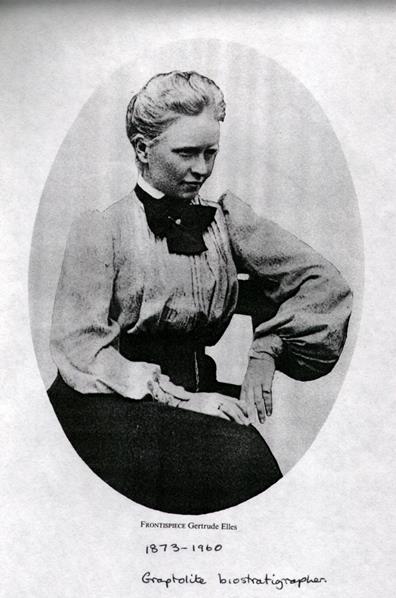
Gertrude Elles (1872-1960) and Ethel Wood (1871-1945) contributed to the acceptance of the Ordovician period by the Geological community. When Professor Lapworth from Birmingham University put forward the idea of an Ordovician period to solve the debate between Adam Sedgwick and Roderick Murchison about the division of the Lower Palaeozoic (Cambrian to Silurian periods), he decided to enlist the help of two female geologists from the so-called Newnham Quartet of palaeontologists. He considered that they would have the patience and perseverance to solve the problem that male geologists lacked (his words). Gertrude Elles (GE) and Ethel Wood (EW) had both studied geology at Cambridge but had not received degrees as Cambridge did not give women degrees until 1948. However, GE went to Dublin to be awarded hers in 1907 crossing Anglesey to get the ferry. Both GE and EW were graptolite experts and spent 18 years producing the 2-volume monograph of British Graptolites which is still the ‘bible’ today. It was edited by Lapworth. Graptolites as extinct fossils was discussed. Both women went on to receive both funds and medals from the Geological Society of London for their research, GE being the first female to receive a medal in 1919. Both became Fellows of the Geological Society of London (FGS) in 1919 after legislation made it illegal to bar membership based on sex (Sex Discrimination (Removal) Act 1919). The two women received further accolades; GE an MBE for her work with the Red Cross during WWI and EW a Damehood for her work on the War Pensions committee and as President of the National Council of Women. Their work on graptolites secured the naming of the Ordovician rocks on Anglesey.
Story 2 Anglesey Serpentine
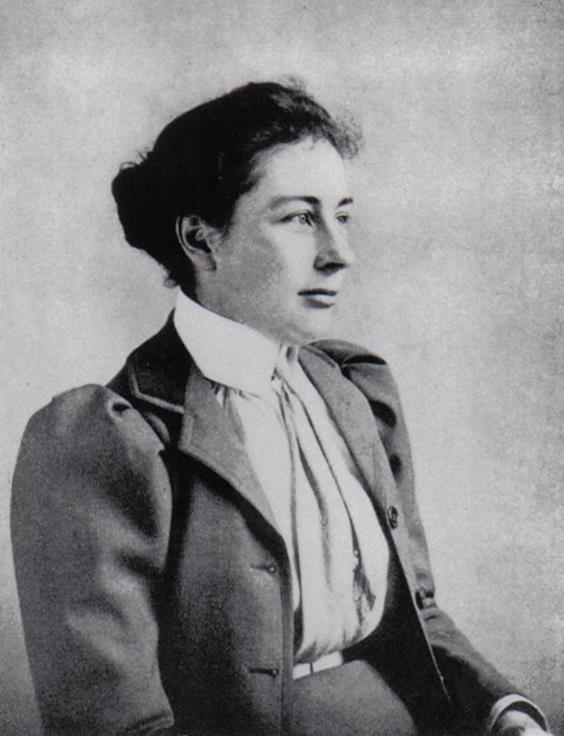
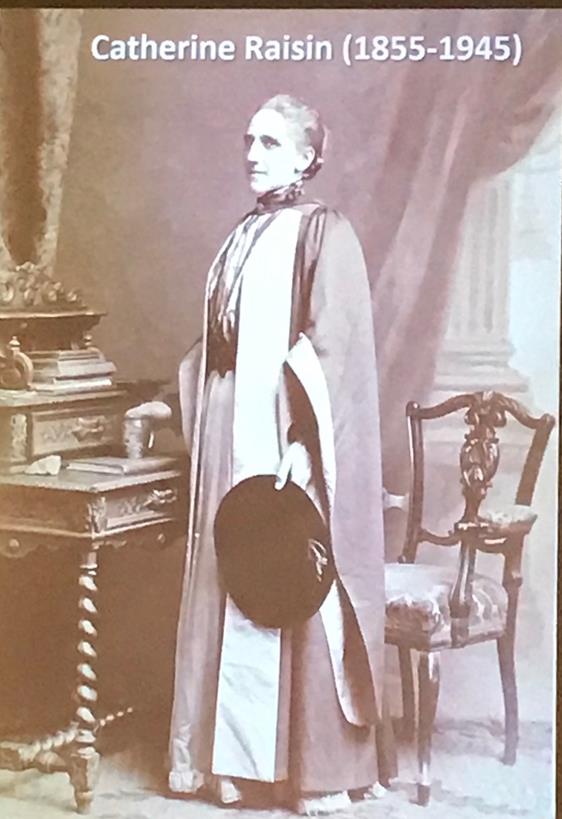
Catherine Raisin (CR) was the first female geological student at University College, London (1880-1884) under Professor Bonney. She became an expert on metamorphism, serpentine (mineral) and serpentinite (rock). Serpentine is a group of hydrous magnesium-rich silicate minerals. It is so-named because it resembles a snake’s skin. Serpentine is usually greyish, white, or green but may be yellow (chrysotile) or green-blue (antigorite); the green colour is due to iron replacing magnesium. It is mainly found on the Lizard peninsula in Cornwall but also in limited amounts on Anglesey. CR did her research while lecturing and running both the geological and botany departments at Bedford College, the oldest female higher educational institution in England. She worked closely with Professor Bonney and undertook fieldwork for him visiting Anglesey many times, collecting serpentine samples after 1888 as he got older. Together they wrote many papers and discussed the age of the oldest rocks on the island with other scientists, disagreeing with Callaway who had mapped the older rocks in the 1870s. CR was the first women to be awarded a research fund from the Geological Society of London in 1893. She was awarded a DSc in 1898 from London University for her research. CR became an FGS in 1919. She retired from Bedford in 1920 at the age of 65. CR was a staunch advocate for female education and non-smoking! An undergraduate Award she set up for a non-smoking geology student is still awarded by Royal Holloway College today.
Story 3 The Story of a wife assistant while mapping Anglesey
Annie Greenly (AG) was not a geologist by training but married one. She dedicated her life to helping her much younger husband Edward, map Anglesey over a period of 25 years. She undertook the role of a ‘wife-assistant’. Edward had been a Geological Survey employee in Scotland, but went as an individual to map Anglesey in 1895. He produced with the help of his wife both a map and a memoir which were acknowledged as excellent by the Geological Survey of Great Britain. Annie was responsible for the logistics of their long stay, finding accommodation, transport as well as editing and indexing Edward’s work. She was responsible for determining the colours on the 1” map, producing the index of his 2-volume memoir which is now preserved in the National Library of Wales as it was unique, and for helping her husband describe the world-first mélange as ‘a mixed, blocks-in-matrix’ rock on Llanddwyn island. This is now considered on the top 100 sites in the world. She died 1 week after completing her editing of his textbook The Earth at the age of 75. AG was an accomplished musician, writer and a North Wales RSPCA supporter. In Greenly’s book A hand through time published many years after her death, he acknowledges her help “We worked on opposite sides of the table; I writing; she ‘doctoring’.” They are buried together in St Cristiolus Church, Llangistiolus on the island. A geological trail has been produced for this graveyard.

The Anglesey geological legacy of four Victorian Women is immense. These 4 women contributed to the advancement of knowledge of GeoMôn geology in different ways but all were pioneers and outstanding women. More can be read about them in two Geological Society of London publications listed below.
- For further information contact Cynthia on c.burek@chester.ac.uk